

Within the race for second seat on Vancouver metropolis council, voters usually are not selecting between candidates with drastically totally different views – two of the candidates, incumbent Erik Paulsen and challenger Kara Tess, share related views on pandemic restoration, local weather change and homelessness.
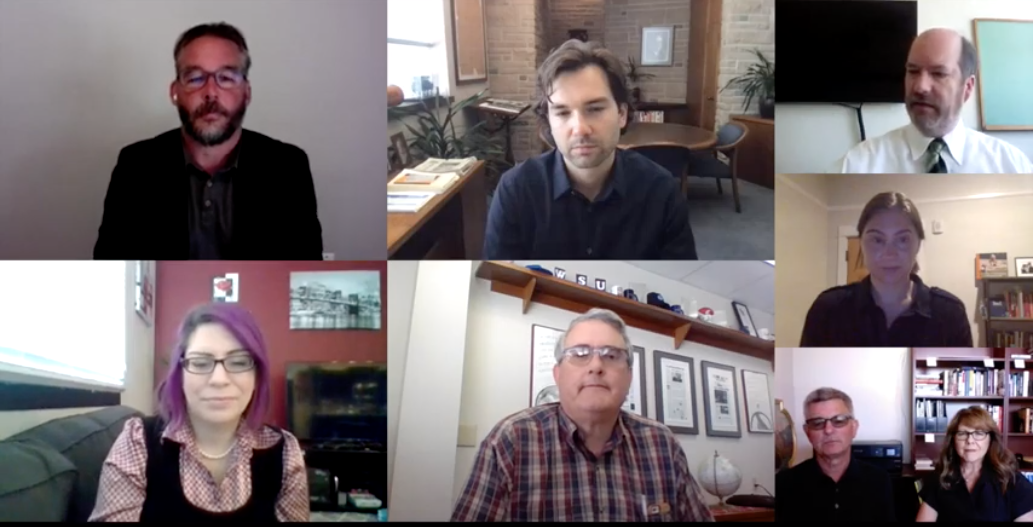
Their essential distinction is in expertise. Paulsen served as president of the Vancouver Planning Fee and the Reasonably priced Housing Job Power earlier than being appointed to the town council in 2019 and re-elected later within the yr. Talking to The Columbian Editorial Board forward of the upcoming primaries, he emphasised his granular experience in native affairs.
“I’m neither an ideologist nor an arsonist. I am in search of broad views, ”mentioned Paulsen. “This can be a pivotal second in Vancouver and we want considerate leaders who perceive our group.”
Tess, a newcomer to politics and a 20-year-old Clark County resident, mentioned she would deliver a much-needed contemporary perspective to the town council, and she or he emphasised her willingness to be taught extra in regards to the particular fundamentals of native authorities.
“I do not settle for donations from anybody. I can’t be influenced. There is no such thing as a cause why I’m not right here to battle for the folks, ”Tess informed the editor. “I am not afraid to be taught and I undoubtedly at all times have an open ear.”
Each praised the native management for his or her actions throughout the peak of the COVID-19 pandemic.
“I’ve seen firsthand that having the masks mandate earlier than 70 or 60 % of individuals had been vaccinated was an amazing determination,” Tess mentioned. “You do not know what you do not know.”
Paulsen added that there’s solely a lot the town can do to masks laws – these mandates come from the state. Nevertheless, he mentioned he stood by how Vancouver had handled the pandemic, citing applications to ease the burden on native small companies, akin to waiving the enterprise license surcharge and implementing the Road Eats program.
“Given the restricted choices out there to us, I feel the town ought to be pleased with our response to COVID,” Paulsen mentioned.
He mentioned he seems ahead to working with the remainder of the town council to resolve how finest to spend the $ 32.6 million federal funding allotted to Vancouver by way of the American Rescue Plan Act.
When requested how finest to spend that pot of cash, Tess mentioned she must “perform a little analysis and attain out to the group and see the place persons are struggling probably the most.”
“There are such a lot of locations that cash may very well be spent that we actually need to look right down to see what the most suitable choice is,” Tess mentioned.
The candidates diverged barely from the town’s present coverage for inexpensive housing. Tess criticized an present program that grants constructing homeowners of multi-family housing tasks tax breaks – the multi-family tax exemption program, as Paulsen later clarified – as “setbacks for property builders”.
“We’re at the moment in a housing disaster with inexpensive housing,” mentioned Tess. “I’d simply be sure that the legal guidelines are higher written in order that they’re accountable to rents and home costs.”
The principles of this system permit builders to obtain the tax break after they worth their properties consistent with the median family revenue within the better Portland space. Paulsen mentioned he disagrees with the current push to overtake this system, requiring builders to set decrease rents – based mostly solely on Vancouver revenue information, not the remainder of the area – to obtain the tax break.
This system has at all times been designed to extend the housing inventory, he mentioned. It isn’t particularly designed to enhance affordability.
“It has efficiently created density in our downtown core,” mentioned Paulsen. “Personally, I consider the Council made the appropriate determination to maintain revenue ranges on the median Portland degree.”
The 2 candidates additionally disagreed on how the town can finest reply to local weather change. Paulsen mentioned he feels the council is already “speaking about the appropriate issues” – Vancouver not too long ago commissioned a fossil gas emissions evaluate to arrange for the event of a broader local weather technique – however it isn’t shifting quick sufficient.
“I feel we’ve got to concentrate on the urgency,” mentioned Paulsen. “I hope we will rapidly agree on a local weather plan that’s bold and places the town in a management place.”
Tess mentioned she agreed that working to enhance the local weather was a worthwhile aim. Nevertheless, she worries in regards to the cost-benefit equation in a metropolis the scale of Vancouver. So long as the federal authorities subsidizes the fossil gas trade, the native authorities can solely accomplish that a lot good, she continued.
“Local weather change is a worldwide situation; and as a metropolis, I feel we’re a lot better off than many different communities, ”mentioned Tess, referring to environmental requirements that may enhance the price of constructing new properties. “How will that have an effect on home costs and inexpensive housing?”
Each Tess and Paulsen seem on Vancouver’s August 3 primaries poll. A 3rd candidate, Tami Martin, didn’t reply to the editorial board’s invitation to attend the assembly.
[ad_2]
