

Two years in the past, Marcel DeBord, 61, earned the appropriate to seek advice from himself as a “B-Man,” a promotion and a proud place within the dockworker world.
In a nine-month interval in 2012, he spent 1,726 hours on the United Grain Corp. terminal. in Vancouver Harbor, drove forklifts and vans and operated locomotives that carried rail automobiles full of grain.
In 2013 as an entire, nevertheless, his variety of hours fell by 33 p.c to 1,156 hours.
The job reduce – and the ensuing influence on his household’s livelihood – started a 12 months in the past right now when United Grain locked out as much as 44 members of the Worldwide Longshore and Warehouse Union.
The corporate’s lawsuit – which was based mostly on the non-public investigator’s conclusion {that a} Longshore member had sabotaged the corporate’s equipment – took place six months after United Grain and the ILWU have been unable to barter a brand new collective settlement.
A 12 months after the lockout, the consequences proceed. Authorized disputes happen in native and nationwide authorized contexts. Regional and state politicians and enterprise leaders hold calling for an answer to a serious battle involving a number of grain terminal operators within the northwest. Though agricultural merchandise proceed to circulation into abroad markets, the contract battle briefly threatened to halt authorities inspections at United Grain, that are essential to hold cargo transferring. An estimated 3.2 million tons of grain are transported by way of the port of Vancouver in a mean 12 months.
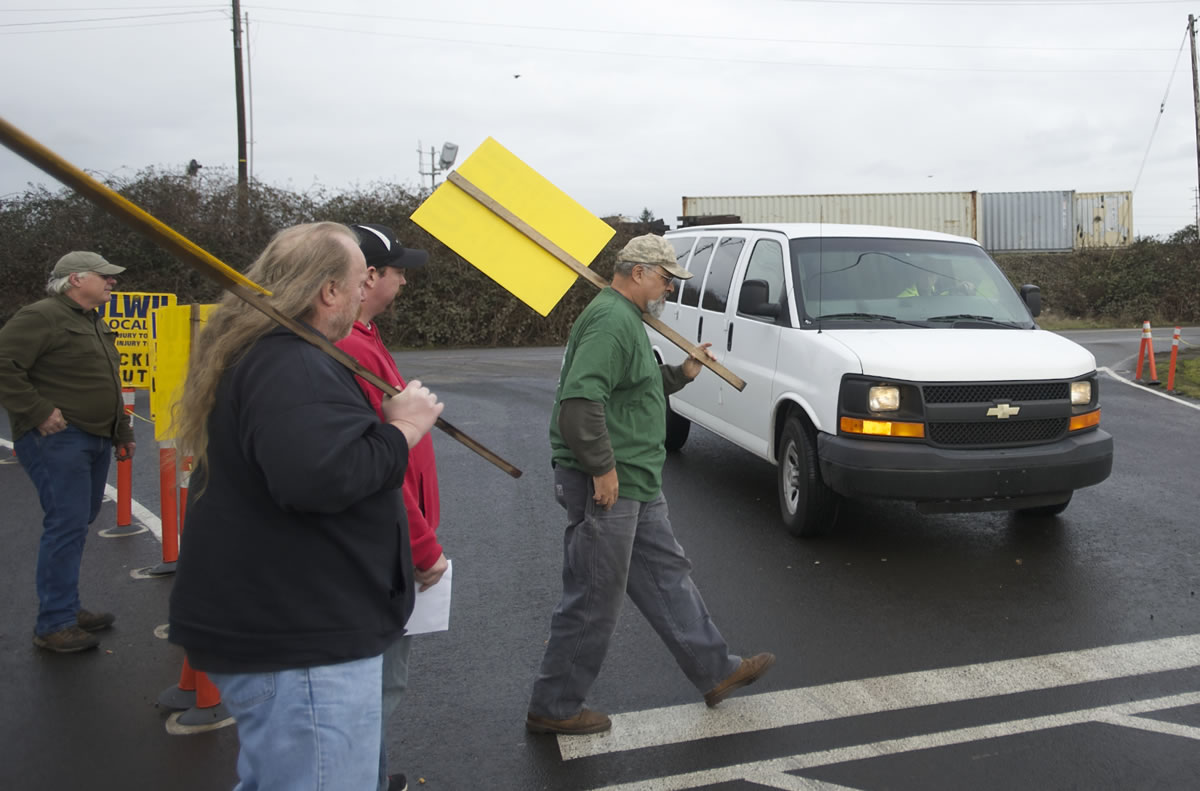
And an incident early Wednesday morning, on the eve of the anniversary of the lockout, underscored the extreme native character of this bitter dispute. A bigger than regular picket line gathered at a gate on the east aspect of the port the place United Grain is transporting non-unionized alternative employees to and from its facility.
Vancouver Police Division spokeswoman Kim Kapp stated the big gathering together with deserted automobiles blocked the close by roadway and the doorway to the United Grain terminal, which is on Thompson Street close to Mill Plain Boulevard.
Kapp stated the police cleared up the state of affairs, which lasted about half-hour. No one was injured. An individual who received out of a automobile and joined the picket line was cited for disorderly habits, Kapp stated.
And whereas the ILWU and United Grain say they hold speaking, dock employees like DeBord are nonetheless injured watching different individuals – some have been taken out of the state – tackle the roles they as soon as owned.
DeBord rushes to work daily – generally he travels to different ports within the space solely to seek out nothing is accessible, and generally he arrives on the Native 4 transport corridor in Vancouver solely to be left empty-handed.
“I am within the corridor day and evening,” he stated, “to see if I can get work.”
Job cuts
United Grain stated it locked out employees after union member Todd Walker broken a grain loading machine. The Clark County Legal professional’s Workplace finally declined to carry expenses in opposition to Walker. Prosecutors stated it was not possible to establish the individual captured on video or to make sure “that the individual within the video is definitely damaging the machine”.
Nonetheless, the corporate is pursuing a civil lawsuit in opposition to Walker searching for greater than $ 300,000 in damages. Walker has described the corporate’s lawsuit as doubtful by way of a Portland legal professional.
In the meantime, different locked-out union members are going through a special sort of stress: a pointy fall in employment.
There are 193 registered longshore employees in Vancouver, together with Class A and B employees. It will probably take 15 years or extra to attain Class A standing. Which means you may have a number of expertise and seniority. A “B” employee is sort of a journeyman, somebody who’s graded after 5 or extra years of labor.
The work within the ports varies in response to the ups and downs of the financial system. In consequence, the personnel necessities of the terminal operators fluctuate. Within the port of Vancouver, the contract dispute and the lockout are restricted to the grain terminal. ILWU members can proceed to work in different port services beneath separate contracts with the Pacific Maritime Affiliation.
However United Grain’s lockout ruling, which can reduce as much as 44 jobs, has restricted employment alternatives for Vancouver union members. And the lockout has additional ramifications for union members in Portland, the place Columbia Grain expelled an estimated 50 to 75 ILWU members in Could.
In Vancouver, ILWU members who would usually go to United Grain to work at the moment are arriving on the transport corridor as an alternative, hoping to open up a a lot smaller pool of jobs, stated Brett Lynch, 46, who’s a Class A dock employee .
It’s one other ripple impact that makes it troublesome to seek out employment even for Class A employees who’re beginning to lose their accessible work. Lynch stated his revenue fell 30 p.c.
It is a nerve-wracking predicament that places Class B employees like DeBord in an excellent nearer place.
The lockout was robust on his household, he stated, and known as their financial safety into query. “My spouse is working now,” he stated. In addition they refinanced their mortgage to take care of it, he stated. He usually goes empty-handed on his lengthy journeys to different ports to seek out work which have taken him anyplace from Tacoma to Coos Bay, Oregon.
In the meantime, what the ILWU calls “casuals” – employees who’re neither class A nor B however have demonstrated sufficient talent to face an opportunity at work within the docks – have been hit significantly arduous by the lockout .
These days, they could solely discover in the future of labor in a single month, stated Jennifer Sargent, an ILWU spokeswoman.
“A good settlement”
The contracts that the ILWU and employers have agreed on through the years embody strong wages and advantages. In addition they comprise different provisions, together with the PGP, which gives a weekly revenue complement to Grade A and B employees who’re unable to get per week of labor.
These employees should meet sure admission necessities. They have to be accessible in a selected wage week and should not have turned down any supplied work for which they’re certified.
Vancouver dock employees, DeBord and Lynch, each acquired “some PGP,” stated Sargent, ILWU spokeswoman, “however it is just a partial wage alternative and has not been sufficient to cushion the lockout’s influence on their households.”
The ILWU and United Grain have declined to touch upon the character of their ongoing contract negotiations, however what they’ve stated publicly previously exhibits that the dispute just isn’t about wages and advantages.
As an alternative, it is about office guidelines and recruitment tips – it is about which aspect good points the higher hand over management of labor points on the shores of the area.
There are few particulars, however two fundamental arguments body the bigger battle between the ILWU and the operators of Northwest Grain Terminals: To extend their competitiveness, the grain merchants desire a new contract that displays the employer-friendly phrases that the ILWU entered into in February 2012 Export Grain has signed a terminal in Longview. Related circumstances apply on the Kalama Export Firm terminal within the port of Kalama.
However the union says claims by United Grain, Columbia Grain in Portland, and Louis Dreyfus Commodities – which function services in Portland and Seattle – are aimed toward breaking the union. And the union says it made concessions whereas nonetheless sustaining honest office insurance policies, in a fixed-term association with Temco, which operates grain export services in Portland, Tacoma and Kalama.
Pat McCormick, spokesman for the Pacific Northwest Grain Handlers Affiliation, which incorporates United Grain, Columbia Grain and Louis Dreyfus Commodities, stated the businesses solely need phrases that the union has already agreed to elsewhere.
“Our curiosity is in reaching a good settlement with the union that can allow us to compete with our colleagues within the grain export enterprise, together with EGT and Kalama Export,” stated McCormick.
He stated United Grain has continued to function easily because the lockout. The corporate has reassigned some non-union employees and its alternative employees, McCormick stated, are “correctly skilled for the duties they’re performing and have the required permits”.
Sargent, the ILWU spokeswoman, stated in an electronic mail to The Columbian that Mitsui – a reference to United Grain’s Japan-based mum or dad firm – “has been, and continues to be, extremely worthwhile beneath our 80-year-old settlement in Vancouver can do”. by sustaining excessive requirements for employees and the group that relies on good jobs.
“Additionally,” she stated, “the EGT Treaty was a primary treaty and, like all first treaties, a place to begin to construct on.”
One 12 months after the lockout, there aren’t any apparent indicators that the battle will finish anytime quickly.
However DeBord, who has lived it each step of the way in which, together with becoming a member of his union members on the picket line, stated he was optimistic {that a} resolution could be reached. “It’s within the pursuits of each side,” he stated, “that it really works.”
[ad_2]
