
Challenges continue for Clark County restaurant owners under new ‘open-air’ guidelines

For restaurant homeowners, the most recent adaptation of the COVID-19 period is a quantity: 450 components per million. That is the utmost quantity of carbon dioxide allowed within the ambient air of an enclosed eating room below the brand new tips for al fresco eating printed by Governor Jay Inslee’s workplace final week.
Indoor areas with poor air flow are at a a lot increased threat of spreading the coronavirus by way of droplets in stagnant air, so the concept is to make use of CO2 ranges as an estimate of airflow. In accordance with the rule of thumb doc, the common CO2 content material outside is 400 ppm; A worth under 450 ppm signifies a superb provide of recent air from exterior.
Inslee imposed a brief ban on all indoor meals in November in response to a surge in COVID-19 instances in Washington. This ban will stay in impact till particular person areas meet the standards to maneuver into the second section of the Wholesome Washington Roadmap to Restoration plan.
The open air tips provide eating places a possible alternative to renew restricted indoor seating sooner if their inside design meets the standards. However it has confirmed to be a troublesome vacation spot for Clark County eating places, and in some instances, has made issues even more durable because the CO2 guidelines additionally apply to the outside eating places which have popped up in latest months.
“I positively admire that they’re making an attempt to assist us, however it may have labored the opposite manner round,” mentioned Mark Matthias, proprietor of the Seashores restaurant.
permeability
In accordance with the brand new tips, each constructing – whether or not a standard constructing or an outer tent – is outlined as “inside” if none of its partitions are permeable, ie no air can movement by way of it.
A wall may be thought of permeable if its building permits it to be partially opened to a major movement of air. However propping up only one door shouldn’t be sufficient; the opening should include a number of giant home windows or bay doorways, as instructed by Inslee’s workplace.
Constructions with no less than one permeable wall are thought of open air and could also be operated with 25 p.c of their traditional seating capability, however provided that they’re outfitted with CO2 displays on web site and might stay under 450 ppm. Constructions with just one wall or just one umbrella or cover don’t require displays.
The brand new guidelines have sparked a scramble to order CO2 displays and adapt current eating places. Throughout a recurring Zoom assembly for restaurant homeowners in Clark County final week, a number of attendees exchanged recommendations on what sort of displays to purchase and the place to select them up.
The displays are comparatively cheap, with a number of fashions listed on Amazon for lower than $ 200. Some eating places could have already got them, mentioned one participant, if they’ve CO2 storage tanks for soda fountains.
Check runs
Some Vancouver restaurateurs began working by the brand new guidelines this week, however the 450ppm goal has confirmed troublesome to attain.
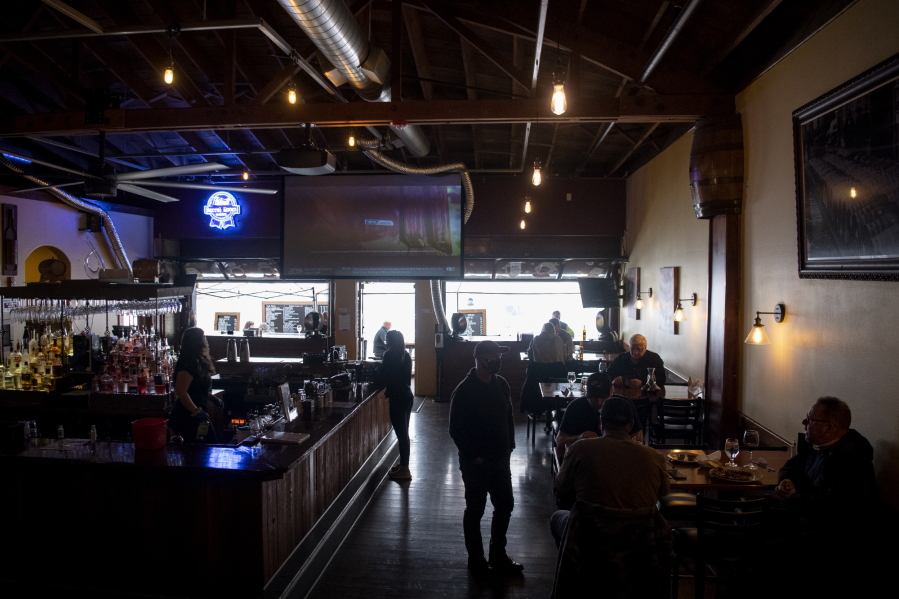
Uptown Barrel Room was lucky to have a great design for the brand new guidelines. The road-facing entrance wall of the restaurant consists of two roll-up storage door-style home windows, every extending nearly half the size of the wall, simply creating sufficient hole to go the permeability take a look at.
The restaurant has a again door that may be opened to create cross air flow, and proprietor Dwayne Christensen mentioned he additionally has giant followers and virus filters for his industrial air system.
“We’ve got all the proper parts, so to talk, and we’ve got a two-heat pump system for our air flow,” he mentioned.
Regardless of all of those advantages, Christensen mentioned his inner CO2 ranges had been round 442 ppm – under the restrict, however not by a lot. A part of the issue is that the surface air wasn’t very recent at first, he mentioned, registering round 410ppm proper exterior the restaurant. Christensen speculated that the upper focus was doubtless resulting from close by roads, significantly Interstate 5.
Matthias mentioned he put in CO2 displays over the weekend after which made a primary try exterior on Monday, counting on the constructing’s bay home windows for air flow.
It labored through the day; the restaurant may keep below the brink and accommodate a couple of dozen tables at a time. However then within the night the CO2 stage immediately jumped to 475 ppm, which required a five-minute break to show the followers up and down once more.
Tent issues
In principle, the brand new guidelines can solely be useful. With indoor consuming already banned, the worst-case situation is solely {that a} restaurant can’t attain the 450ppm mark and should keep closed.
The issue, in keeping with Matthias, is that the brand new CO2 guidelines additionally apply to tents and different outside services, the place homeowners beforehand solely needed to cope with constructing physics necessities.
It is a new wrinkle in an issue that outside seating eating places have been dealing with for a number of months: the necessity for a tent setting that’s dry and heat sufficient to be comfy with out de facto indoor construction turn out to be. Rolling up the tent partitions brings in recent air, however it’s additionally freezing air right now of yr.
“We simply had good climate,” mentioned Matthias. “If it goes within the different course and it is 30 or 35 levels all day, you simply do not wish to sit in it.”
The identical downside can happen indoors. Grains of Wrath in Camas introduced on Fb that it will reopen earlier this week for restricted indoor eating, however the publish warned that the restaurant’s storage doorways would should be open and inspired diners to band collectively.
One potential answer is to equip tents with giant heaters to compensate for wind chill from air flow, however the brand new necessities make this method tougher as the warmers themselves can improve CO2 ranges.
“That will probably be one of many dilemmas,” mentioned Christensen. “I do know lots of people use propane in these tents.”
[ad_2]
